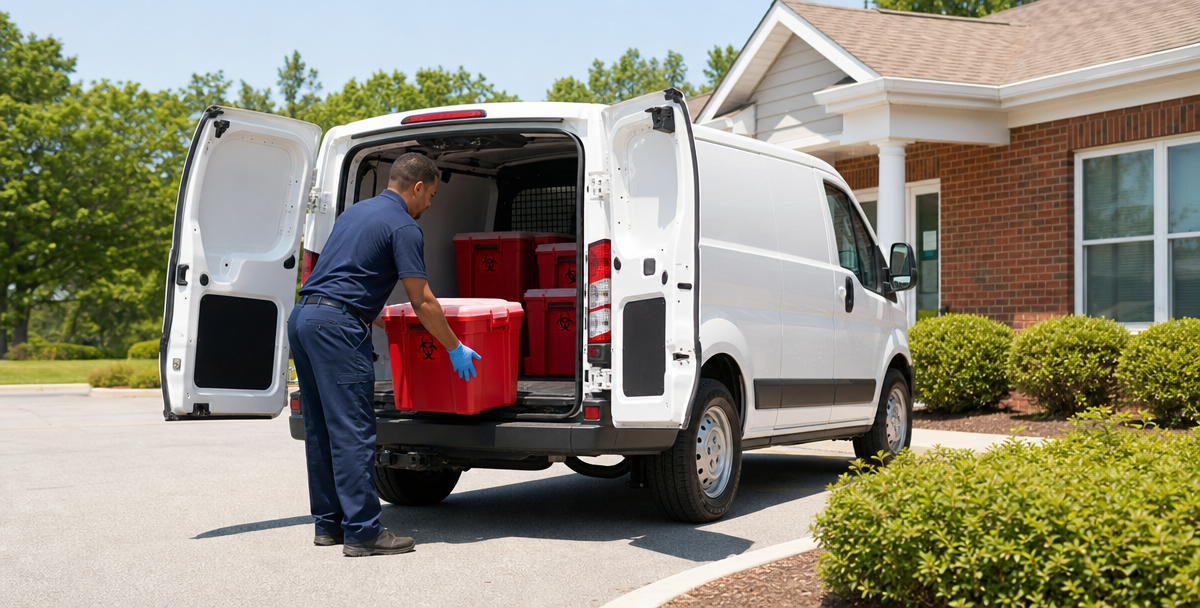
Since the onset of the pandemic, COVID medical waste disposal in Massachusetts has become a pressing concern for healthcare providers, testing sites, schools, and businesses. While the acute phase of COVID-19 has passed, SARS-CoV-2 continues to circulate — and the waste it generates, from rapid antigen test kits to used PPE, doesn’t simply disappear. If your Massachusetts practice, clinic, or business is generating COVID-related waste, understanding how to manage it correctly isn’t optional. It’s a legal and public health obligation.
This guide walks through what qualifies as COVID-related regulated medical waste, what Massachusetts regulations require, and how to set up a compliant disposal program that protects your staff, patients, and bottom line.
What Counts as COVID-19 Medical Waste?
Not all COVID-related materials automatically qualify as regulated medical waste under Massachusetts law — but many do, especially if they’ve been in contact with blood, bodily fluids, or potentially infectious specimens. Massachusetts follows guidelines set by the Massachusetts Department of Public Health (MDPH) and the EPA, both of which classify certain COVID-19 waste as infectious or biohazardous.
Common COVID Waste Types That May Require Regulated Disposal
- Used rapid antigen or PCR test kits — nasal swabs, test cassettes, and collection tubes that have contacted patient specimens
- Personal protective equipment (PPE) — gloves, gowns, face shields, and masks used in clinical settings or during direct patient care
- Needles and syringes — used to administer COVID-19 vaccines or draw blood for diagnostic testing
- Specimen collection materials — vials, swabs, and transport media from laboratory testing
- Isolation waste — materials generated in rooms or areas used for COVID-19 patient isolation or treatment
- Blood or bodily fluid-contaminated materials — any absorbent items saturated with potentially infectious fluids
Routine administrative waste — unopened PPE, packaging materials, paper records — does not qualify as regulated medical waste and may generally be disposed of as ordinary trash. When in doubt, treat the item as biohazardous. The cost of proper disposal is always less than a regulatory fine or enforcement action.
Massachusetts COVID Waste Regulations: What You Need to Know
Massachusetts regulates infectious and medical waste under 105 CMR 480.000, the state’s Minimum Requirements for the Management of Medical or Biological Waste. Under these rules, any generator of medical waste — including COVID-19-related waste — must comply with requirements for containment, labeling, storage, transport, and disposal. COVID medical waste disposal in Massachusetts is not a gray area; the state takes these requirements seriously.
Proper Containment and Labeling
Infectious COVID waste must be placed in leak-proof, puncture-resistant containers before leaving the point of generation. Red biohazard bags are required for soft, non-sharp waste — used gowns, masks, gloves, test kit materials, and isolation waste. Sharps, including vaccine needles and lancets, must go into FDA-cleared, rigid sharps containers. All containers must be sealed and must display the universal biohazard symbol. Unlabeled or improperly sealed containers are a direct regulatory violation.
Authorized Transport and Disposal Only
Massachusetts law requires that regulated medical waste be picked up and transported exclusively by a licensed infectious waste hauler and treated at an approved facility. You cannot dispose of regulated COVID waste in your regular dumpster, flush it down a drain, or transfer it to an unlicensed party. Violations expose your business to significant penalties from the MDPH, EPA, and OSHA — and in serious cases, personal liability for facility managers and owners.
Generator Recordkeeping Requirements
Even smaller generators are strongly advised to maintain basic records of their medical waste pickups, including manifest or tracking documents provided by your hauler after each service. These records are your proof of compliance during an inspection. Reputable licensed medical waste companies automatically provide this documentation with every pickup, so you don’t need to create any additional paperwork systems.
COVID Vaccine Waste: A Special Case
Healthcare providers who administered COVID-19 vaccines — and many who continue to administer annual updated formulations — face specific requirements around vaccine-related waste. Used syringes and needles from vaccine administration are sharps waste and must be placed in approved sharps containers collected by a licensed hauler. This applies whether you’re administering vaccines in a hospital system, a standalone clinic, a pharmacy, or a community health setting.
Unused or expired COVID vaccines being discarded may also qualify as pharmaceutical waste, depending on the formulation. Pharmaceutical waste disposal is governed by both EPA regulations and, in some cases, DEA requirements. If your practice is sitting on expired COVID vaccine stock, do not mix it with standard sharps or red bag waste. Contact a licensed Massachusetts medical waste provider to discuss pharmaceutical waste disposal options specific to your situation and volume.
COVID Waste at Non-Healthcare Businesses and Schools
Many non-clinical settings — schools, gyms, corporate offices, retail businesses, and event venues — conducted COVID rapid testing at scale during the height of the pandemic. Some continue to do so for employee health programs or community wellness initiatives. These organizations may not think of themselves as medical waste generators, but if they’re regularly collecting used test kits that contact nasal or saliva specimens, they may well be.
Massachusetts does not exempt non-healthcare businesses from medical waste regulations simply because healthcare isn’t their primary activity. If your organization is generating COVID test waste at any meaningful volume, consult with a licensed Massachusetts medical waste hauler to determine whether a formal service agreement is appropriate. Many providers offer flexible, low-minimum programs tailored for non-clinical settings.
How to Set Up COVID Medical Waste Disposal in Massachusetts
Setting up proper COVID medical waste disposal in Massachusetts is straightforward when you work with the right partner. Here’s how the process typically works:
- Assess your waste volume — Estimate how many red bags and/or sharps containers your operation generates per month. This determines what container sizes and pickup frequency make sense for your situation.
- Choose your containers — Your hauler will provide or recommend appropriate biohazard bags, rigid red bins, and sharps containers sized for your waste stream and storage space.
- Schedule service — Massachusetts regulations require that medical waste not be stored on-site for more than 30 days. Most practices schedule monthly or bi-monthly pickups based on volume, though high-volume generators may need more frequent service.
- Receive disposal documentation — After each pickup, your hauler provides a manifest or certificate of disposal for your compliance records. Keep these on file.
- Stay current — COVID-related guidance continues to evolve at both the state and federal level. Check in periodically with your hauler or the MDPH to confirm you’re meeting current requirements, especially if your waste volumes change significantly.
There’s no need for a long-term contract or complicated setup. A reputable local hauler will work with your schedule and volume, not lock you into a one-size-fits-all enterprise plan designed for a hospital system.
Why Choose a Local Massachusetts Medical Waste Company
Large national waste companies often struggle to provide the flexibility and responsiveness that smaller Massachusetts practices and businesses need — especially for a waste stream like COVID materials, which can fluctuate significantly with case surges, vaccine campaigns, or changes in testing protocols. Local haulers are more responsive to scheduling changes, more familiar with state-specific regulatory requirements, and far easier to reach when questions or emergencies arise.
Massachusetts Medical Waste Collection specializes in serving healthcare providers, testing sites, schools, dental offices, tattoo studios, veterinary clinics, and businesses across the Commonwealth. We understand the nuances of COVID medical waste disposal in Massachusetts and can help you build a compliant, cost-effective program — whether you’re generating a few bags a month or running a high-volume testing or vaccination operation. No long-term contracts, no hidden fees, and real local support when you need it.
Ready to Set Up Compliant Medical Waste Disposal?
Massachusetts Medical Waste Collection serves clinics, dental offices, tattoo studios, and more across the region. Get a free quote — no long-term contracts required.
Leave a Reply