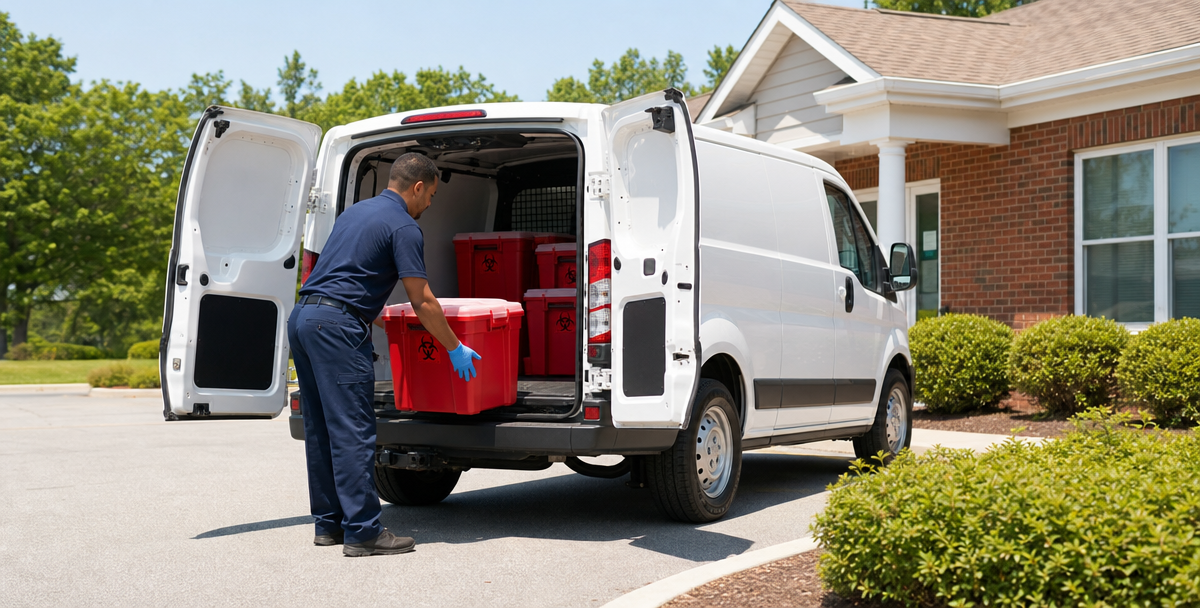
If you run a healthcare practice in Massachusetts, you’re juggling two overlapping sets of rules: OSHA’s Bloodborne Pathogen Standard (29 CFR 1910.1030) at the federal level, and the Massachusetts Department of Public Health (MDPH) medical waste regulations at the state level. Staying compliant isn’t optional — violations can result in fines, facility shutdowns, and personal liability.
Here’s a plain-English breakdown of what you need to know.
What Counts as Regulated Medical Waste in Massachusetts?
Massachusetts defines regulated medical waste broadly. The following categories must be handled and disposed of through a licensed medical waste hauler like Massachusetts Medical Waste Collection:
- Sharps — needles, syringes, lancets, scalpel blades
- Pathological waste — human tissues, organs, body parts
- Microbiological waste — cultures, specimens, live vaccines
- Blood and blood products — saturated items, liquid blood
- Isolation waste — waste from highly communicable patients
OSHA Bloodborne Pathogen Standard: The Basics
OSHA’s standard applies to any employer whose workers may be exposed to blood or other potentially infectious materials (OPIM). For most healthcare practices, that’s virtually everyone in the clinical area. Here’s what OSHA requires:
1. Exposure Control Plan (ECP)
Every covered employer must maintain a written ECP — updated annually — that identifies at-risk job classifications, methods of compliance, and post-exposure procedures.
2. Engineering Controls
Sharps disposal containers must be closable, puncture-resistant, leak-proof on sides and bottom, and labeled with the biohazard symbol. They must be placed as close as feasible to the point of use and replaced routinely before they are completely full.
3. Personal Protective Equipment (PPE)
Gloves, face shields, and gowns must be provided when employees may contact blood or OPIM. Single-use PPE that has contacted infectious material is regulated medical waste and must be disposed of properly.
4. Training
Annual bloodborne pathogen training is mandatory for all at-risk employees. Training must be provided at no cost and during work hours.
5. Hepatitis B Vaccination
Employers must offer Hep B vaccination to at-risk employees at no cost within 10 days of initial assignment.
Massachusetts-Specific Requirements
Beyond OSHA, Massachusetts 105 CMR 480.000 governs infectious and pathological waste. Key additions include:
- Licensed haulers only — you must use a MDPH-licensed transporter (like Massachusetts Medical Waste Collection)
- Treatment before disposal — waste must be treated (autoclaved or incinerated) before going to a licensed landfill
- Manifests — a written manifest must accompany each waste shipment and be retained for 3 years
- Container labeling — all containers must be marked “BIOMEDICAL WASTE” with the generator’s name and address
Common Compliance Mistakes to Avoid
- Overfilling sharps containers — containers should be replaced at the fill line (typically ¾ full), never overpacked
- Mixing waste types — regular trash mixed with regulated waste creates liability
- No written ECP — this is the #1 OSHA citation for medical offices
- Using unlicensed haulers — saves money short-term, creates massive liability
- Expired manifests — keep records for at least 3 years
How Massachusetts Medical Waste Collection Keeps You Compliant
We handle the entire compliance chain for you — from providing the right containers, to scheduled pickup, to certified treatment and manifest documentation. Every pickup includes documentation you can keep on file for OSHA or MDPH inspections.
Boston,
Worcester,
Merrimack Valley,
South Shore,
North Shore,
MetroWest,
Fall River,
Southern New Hampshire, and
Providence, RI.
Ready to Set Up Compliant Medical Waste Disposal?
Massachusetts Medical Waste Collection serves clinics, dental offices, tattoo studios, and more across the region. Get a free quote — no long-term contracts required.
Leave a Reply